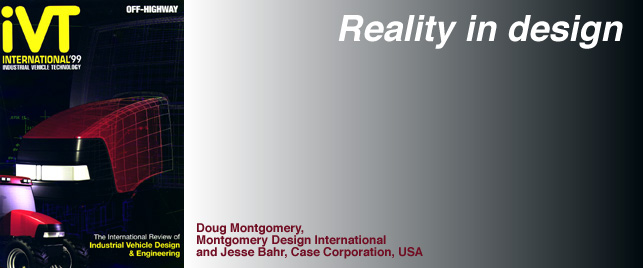
In May 1998, Case Corporation / Case United Kingdom launched the MXc Compact model designation series tractor, a new machine, that was realised within a project time line of fifteen months, compared with the usual three or four years. In addition to meeting customer driven goals, the resultant design helped establish a trend of getting new products to market with unprecedented speed and efficiency. This level of efficiency also garnered the 1998 Michelin Excellence Award for Case United Kingdom, in recognition of the teamwork in developing the new CX tractor line.
Through the use of advanced computer technology during the development process, Case has greatly reduced development time while enhancing the flow of accurate design data between the various international groups involved in industrial design, engineering and manufacturing.
The foundation of software used for the MXc project was formed by the integrated use of Adobe Photoshop and Alias/Wavefront's Studio software for the industrial design development with Parametric Technology Corporation's Pro/Engineer for the engineering and detail design.
Case project team members contracted Montgomery Design International in mid April of 1997 to develop the MXc series hood enclosure. MDI had recently assisted the Case Design Center in developing the hood concepts and family appearance for the new generation MX Maxxum and MX Magnum hoods. The established design theme was required to carry through into the new MXc tractor. This hood was also required to accommodate a market-driven move towards increased hood slope to provide better visibility. This resulted in the revolutionary styling and practicality of the the new MXc series.
Work began in Adobe Photoshop, developing 2D digital illustrations over existing product photos in order to ensure an accurate representation of the new design. Photoshop is an image manipulation software with a suite of tools and effects that can be applied to photographic images. Composite images can be generated with combinations of photos, computer generated renderings, and 'painted' elements and details. This digital method of work is replacing the traditional felt tip marker renderings, although the techniques and tools that are used in the computer still require the same drawing skills and knowledge of light, shadow, and reflections that are applied to traditional illustrations. This ia a time saving method of working because each iteration does not require a complete redraw of common elements. Additionally, the accuracy of the concepts is improved due to the fact that the existing photos inherently constrain the proportions of the digitally 'painted' elements.
Hood variations were digitally painted over the existing photographs to review various shapes and design details at photographic quality. Manufacturing concerns were also considered, even at this early stage. It is important in this brainstorming phase that the conceptual and form development can be explored quickly and effectively with many variations. In this phase the concepts ranged from mild updates to more radical departures. Exploring concepts that push the boundaries helped to free the minds of the development team and allow the design to progress to a more advanced level than it might otherwise have done. Ultimately the concept selection process resulted in a design path that was an incremental evolution of the existing products.
Following review and approval of the selected design, the next step was to carry the selected concept into Alias Studio for surface modeling and evaluation. Alias software provides a freeform visual approach to conceptual surface development that is most conducive to the industrial design and styling effort. Alias Studio is a high-end surface development and visualization package that is used by virtually all of the major automobile companies. It provides powerful tools for the development of complex surfacing with the high quality demanded in automotive body design. Tools for surface evaluation are provided, such as highlight and curvature analysis. Alias also provides the capability to develop photo-realistic renderings and animations of the computer data to aid in evaluation of the design.
Pro/Engineer IGES files of critical engine components- cab, glass, fenders, etc - were provided by Case Engineering and imported into Alias as a basis for the hood development. IGES is a universal translation language for CAD data that allows the transfer of data across different CAD platforms. This imported data provided the necessary constraints to accommodate functional clearances and features such as hood tilt for engine access. Tires and wheels were modeled in Alias by the Case Industrial Design department so that resulting computer renderings of the machine would be complete. Additionally, two different headlight models were imported from Pro/Engineer for potential use in the MX hood, the older production Maxxum headlight, and the MX Magnum update headlight. Through data transfer it was possible to effectively evaluate the potential incorporation of these existing light components in the new hood design.
Initially, MDI developed two surface models of the hood with varying degrees of slope, and then developed photo-realistic renderings for evaluation by the design team. The Alias renderings provide a level of realism, with lighting effects, reflections, textures and environmental controls, that allowed the team to make aesthetic decisions with confidence that they would not necessarily have from viewing sketches or illustrations.
As the concept was further refined, the surface modeling for the various hood and grille parts was completed to the highest degree of surface continuity possible. High levels of surface continuity are necessary on this type of automotive quality body surfacing when outputting to manufacturing. This is commonly considered curvature continuity, in which surfaces are not only tangent at a common boundary, but also where curvature from one surface is carried on for a distance across the boundary to the next surface. This ensures the smoothest flow of highlights across the surfaces. Simple tangency will cause a hard, immediate transition at the surface boundary which will look objectionable as highlights traverse across the surfaces. Surface modeling techniques are preferred over solid modeling for this type of compound body surface development due to the greater control the designer has over the surface intersections and blending.
It is crucial that the construction tolerances are set in Alias to match those of Pro/Engineer. Alias provides a preset in the tolerance preferences that allows the user to match those of Pro/Engineer. Another concern when working between Alias and Pro/Engineer is the level of mathematics in the curves used to build surfaces. Alias is capable of up to degree 7 curves. Degree 5 and 7 curves are generally used in automotive design. They are slower in computations due to the higher control point density but provide smoother curves, better internal continuity, and greater control. Pro/Engineer utilizes a maximum degree 3 curve which helps in working with the geometry more quickly, but this difference needs to be considered. This difference when modeling in Alias for output to Pro/Engineer means that curves no greater than degree 3 should be used. This will improve compatibility as any higher degree geometry brought into Pro/Engineer would be rebuilt to reflect degree 3 mathematics.
Files of the 'A' side or outer surfaces for the hood, upper and lower grille, and light housing were output to the Case MXc Engineering group in IGES format. In later transfers, STEP format was used for improved accuracy. Once the industrial design data was transferred to Pro/Engineer, the Case design engineers added material thickness, flange detailing and groove profiles to the hood and grille, completed the light housing and created solid models. Fastening techniques were explored and integrated into the model. This separation of tasks best utilized the strengths of the different software as well as the different design groups.
As the design evolved, additional clearance to the radiator cap was required, which prompted MDI to quickly modify the Alias model and input it back into Pro/Engineer via IGES translation. Evolutionary design changes are inevitable so it is important to plan with flexible computer modeling procedures. There is an optimal work flow in Pro/Engineer that enhances the utilization of IGES features in the model. In the Pro/Engineer model, secondary feature references should be non- IGES specific. Secondary features should reference the coordinate systems, datum planes, or other features prior to or not dependent on the IGES file. This will keep the Pro/Engineer model as flexible as possible and allow for changes that would require inserting an updated IGES feature.
It was important that the hood model be flexible enough to accommodate functional changes such as the addition of louvers as well as changes due to manufacturing that might include parting lines and different material choices. This work flow was combined into the development of corporate branding and additional cosmetic parts.
Finalized Pro/Engineer models were released for low lead time production methods to develop a limited initial run of composite hoods. It was necessary to have these first-run hoods as quickly as possible to help further resolve fit and assembly issues, as well as to confirm decisions that had been made during computer development. Ultimately the data was output for high volume production tooling.
This methodology between the two computer modeling systems streamlined the development process, eliminated redundant building of computer models, and helped maintain the integrity of the design throughout the development process.
According to Bill Adamson, small tractor engineering manager for Case, the design methodology and systems used to develop the MXc series hood and grille proved to be very time- and cost-effective, with each step in the process adding value and building on the previous step. "By transferring data electronically from MDI to Case Engineering to the prototype and production suppliers, time and expenses were reduced and accuracy increased over conventional methods. Prototype hoods and grilles were operating on field test tractors less than six months from the start of the project and were in full production in just over a year," stated Adamson.
To achieve this efficiency and speed of development is truly a group effort. It requires good communication, information, and expertise at all levels. This project represents a cooperative effort with the common goal of combining these multilevel activities to create the best product as efficiently as possible.
The technology provides excellent tools to speed development with increased accuracy, but the key is still the human element - teamwork.